
Tretinoin Cream for Hair Growth: Does It Really Work for Hair Loss?
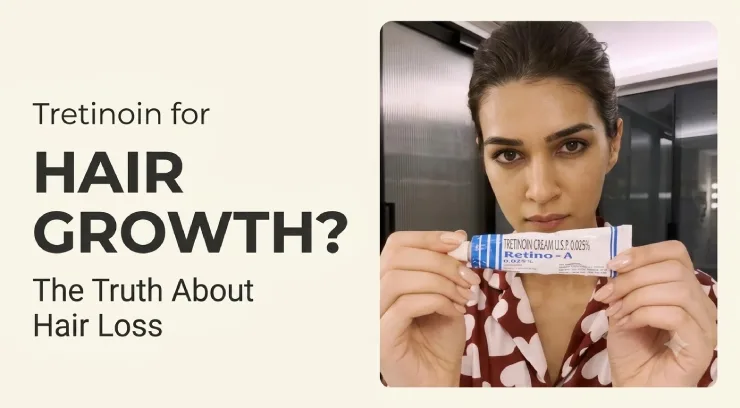
Reviewed by Dr. Sarah Mitchell, Board-Certified Dermatologist | 12 min read |
Key Takeaways:
Tretinoin alone isn’t a primary hair loss treatment, but it’s a powerful adjuvant therapy.
Its main superpower is enhancing the absorption and efficacy of minoxidil in non-responders.
It works by increasing cell turnover, improving blood flow, and upregulating growth factors.
It’s not FDA-approved for hair loss, so use requires a prescription and careful monitoring.
The Search for a Hair Loss Solution
If you’re one of the millions researching hair loss treatments, you’ve likely encountered the big names: minoxidil, finasteride, and ketoconazole. But deep in dermatology forums and clinical studies, a skincare ingredient keeps surfacing—tretinoin.
Known primarily as the gold standard for acne and anti-aging, tretinoin (Retin-A) is now being whispered about as a secret weapon for hair regrowth. Can a retinoid cream really help with a receding hairline or thinning crown?
The answer is nuanced. Tretinoin isn’t a standalone miracle cure, but the science suggests it could be the missing piece for people who’ve failed traditional therapies. Let’s dive into the data, separating hype from reality.
What Is Tretinoin and How Does It Work on Skin?
Tretinoin is a prescription-strength retinoid derived from Vitamin A. It works by binding to retinoid receptors in skin cells, dramatically accelerating cellular turnover. In skincare, this translates to:
Unclogging pores
Boosting collagen production
Shedding old, damaged skin cells
But how does this relate to hair? The scalp is skin. The hair follicle is a mini-organ buried within that skin. A sluggish, inflamed, or keratin-clogged scalp environment can suffocate follicles. Tretinoin’s ability to “wake up” skin cells provides the theoretical foundation for its role in hair regrowth.
The Science: Can Tretinoin Really Regrow Hair?
The data is compelling, though primarily focused on combination therapy, not monotherapy.
1. The Minoxidil Absorption Problem
Minoxidil is the only FDA-approved topical medication for androgenetic alopecia (male and female pattern baldness). However, a significant problem exists: up to 40-50% of users are non-responders.
The issue is an enzyme in the scalp called sulfotransferase. Minoxidil is a prodrug; it must be converted by sulfotransferase into its active form, minoxidil sulfate, to work. If your scalp lacks this enzyme, minoxidil does nothing.
This is where tretinoin comes in. A landmark study in the Journal of the American Academy of Dermatology demonstrated that tretinoin dramatically upregulates sulfotransferase activity. When combined with tretinoin, previous non-responders to minoxidil became responders, showing visible regrowth.
2. Enhanced Drug Penetration
The stratum corneum (the skin’s outer barrier) can block minoxidil absorption. Tretinoin thins this barrier, effectively acting as a penetration enhancer. This allows a higher concentration of the active drug to reach the follicle bulb.
3. Proliferative and Anti-Inflammatory Effects
Animal studies have shown that topical retinoids can:
Promote the transition of hair follicles from the resting (telogen) phase to the growth (anagen) phase.
Increase vascular endothelial growth factor (VEGF), stimulating the formation of new blood vessels around the follicle, delivering more oxygen and nutrients.
Reduce inflammation around the follicle, a key factor in conditions like scarring alopecia.
The Verdict: As a standalone treatment, there’s no robust evidence tretinoin stops genetic hair loss. As a booster for minoxidil, the evidence is strong.
Clinical Studies at a Glance
| Study Focus | Key Finding | Relevance |
|---|---|---|
| Combination Therapy (JAAD) | 0.01% Tretinoin + 5% Minoxidil | Superior to minoxidil alone in non-responders; reactivated sulfotransferase enzymes. |
| Penetration Enhancement | Pre-treatment with retinoic acid | Significantly increased percutaneous absorption of minoxidil. |
| Animal Model (Mice) | Topical Tretinoin | Induced anagen phase and produced thicker, denser hair shafts. |
| Stability | Formulation analysis | Tretinoin degrades minoxidil if mixed directly in a bottle; they must be applied sequentially or in a stabilized formula. |
Always look for medically-reviewed sources rather than anecdotal reports.
How to Use Tretinoin for Hair Loss (Protocol)
If you and your dermatologist decide this is right for you, it’s not just a matter of smearing Retin-A on your head. Proper application is critical to avoid a chemical disaster.
The “Sequential Application” Method
Never pre-mix tretinoin cream and liquid minoxidil in a bottle; the tretinoin can oxidize the minoxidil, rendering both useless. Use them in sequence:
Cleanse: Wash your scalp with a gentle, sulfate-free shampoo. Ensure the scalp is completely dry.
Apply Tretinoin: Apply a pea-sized amount of tretinoin (typically 0.01% to 0.025% strength) directly to the thinning areas. Massage it in.
Wait 20-30 Minutes: This is the crucial step. Allow the retinoid to be fully absorbed and for the skin’s pH to normalize.
Apply Minoxidil: Apply your standard dose of minoxidil foam or solution.
Moisturize: Tretinoin can be drying. Consider a non-comedogenic scalp moisturizer or hyaluronic acid serum 30 minutes later.
Frequency: Start slowly—once every three nights. Scalp skin is sensitive. If no excessive flaking or irritation occurs, increase to nightly use.
Tretinoin vs. Other Topical Hair Loss Treatments
| Treatment | Mechanism | Best For | Tretinoin Synergy? |
|---|---|---|---|
| Minoxidil | Vasodilator, K+ channel opener | Androgenetic Alopecia | High. Tretinoin converts non-responders. |
| Finasteride (Topical) | 5AR Inhibitor (blocks DHT) | Androgenetic Alopecia | Low. Different pathways; irritation risk may increase. |
| Ketoconazole | Antifungal, anti-androgenic | Seborrheic Dermatitis, AGA | Moderate. Addresses different components of follicle stress. |
| Microneedling | Mechanical injury, growth factors | All types, especially with minoxidil | Very High. Tretinoin post-microneedling boosts collagen but dramatically increases irritation risk; do not combine on the same night. |
Side Effects and Risks: The “Retinoid Uglies” of the Scalp
The scalp is rich in blood vessels and nerve endings. The irritation potential here is higher than on the face.
Retinoid Dermatitis: Redness, scaling, burning, and peeling. This is a sign to slow frequency, not a sign of efficacy.
Sun Sensitivity: A thinning scalp combined with tretinoin is a recipe for sunburn. Daily UV protection (hats or SPF) is non-negotiable.
Initial Shedding (“Dread Shed”): Like minoxidil, tretinoin can synchronize hair follicles, causing a temporary increase in shedding before the growth phase begins. This can last 4-6 weeks.
Breakage: Tretinoin can dry out the hair shaft itself if applied carelessly. Apply to the scalp skin, not the hair.
FAQ: Your Tretinoin Hair Growth Questions Answered
Q: Can I just use over-the-counter retinol instead?
A: Technically yes, but it’s less effective. Retinol must undergo two conversion steps in the skin to become retinoic acid (tretinoin). This process is inefficient, meaning far less active ingredient reaches the follicle. Prescription tretinoin is direct and potent.
Q: Does tretinoin block DHT?
A: No. It doesn’t interact with the 5-alpha-reductase enzyme or androgen receptors. It doesn’t stop the hormonal driver of pattern baldness. It optimizes the scalp environment for growth despite DHT.
Q: What’s the ideal tretinoin percentage?
A: Most studies use low strengths: 0.01% to 0.025%. Standard anti-aging creams (0.05% or 0.1%) are usually too irritating for the scalp.
Q: How long until I see results?
A: Patience is critical. Like minoxidil, the hair cycle dictates a timeline. Expect to see reduced shedding at 3 months and visible regrowth at 6-12 months.
The Final Verdict: Is It Worth It?
Tretinoin is not a first-line hair loss treatment. You wouldn’t trade minoxidil for Retin-A.
However, for the minoxidil non-responder, tretinoin is arguably the most scientifically-backed adjuvant available. It solves the specific biological problem of sulfotransferase deficiency. It transforms an ineffective treatment into a viable one.
The Bottom Line: If you’ve used minoxidil religiously for 6-9 months with zero results, the problem is your scalp chemistry, not your willpower. Adding tretinoin could be the catalyst that unlocks your response. It’s a high-risk, high-reward strategy—the risk being scalp irritation, the reward being hair regrowth.
Always consult a board-certified dermatologist to rule out other causes of hair loss and obtain a valid prescription. Do not purchase tretinoin from unregulated online pharmacies.
Medical Disclaimer: This content is for informational and educational purposes only. It is not intended to be a substitute for professional medical advice, diagnosis, or treatment. Always seek the advice of your physician with any questions regarding a medical condition.