
DL Full Form in Medical: Meaning, Uses, and Importance
In the medical field, abbreviations are widely used to simplify communication among healthcare professionals. One such commonly used term is DL. Understanding its full form and context is important for students, professionals, and even patients who come across medical reports or prescriptions.
What is the Full Form of DL in Medical?
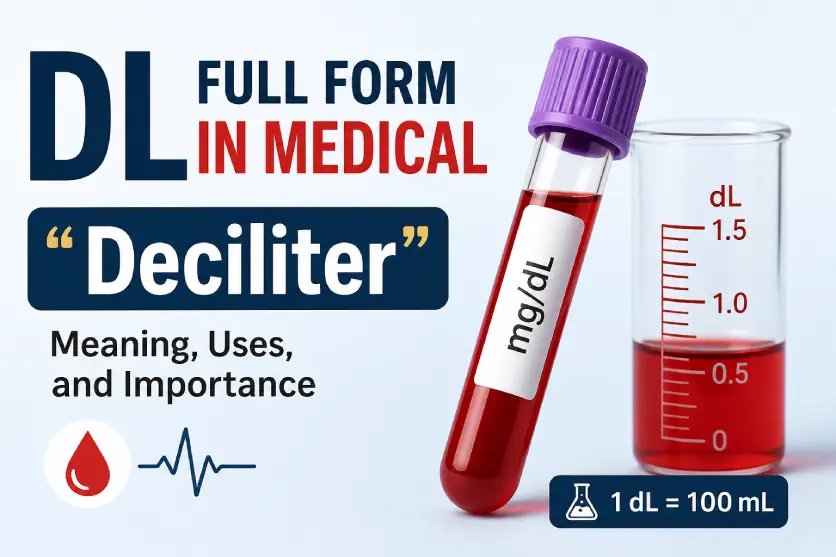
DL full form in medical is “Deciliter” (dL).
A deciliter (dL) is a unit of volume in the metric system, equal to one-tenth (1/10) of a liter. It is frequently used in medical and laboratory measurements, especially in blood test reports.
Why is DL Used in Medical Terms?
In healthcare, precise measurement is critical. The unit dL (deciliter) is used because:
- It provides a standardized way to measure concentrations in blood
- It helps in reporting lab values clearly
- It ensures consistency across medical reports worldwide
Common Medical Measurements Using DL
You will often see dL used in blood test results. Some common examples include:
1. Blood Glucose Levels
- Reported as mg/dL (milligrams per deciliter)
- Used to diagnose and monitor diabetes
- Example: Normal fasting blood sugar is around 70–100 mg/dL
2. Hemoglobin Levels
- Measured in g/dL (grams per deciliter)
- Indicates oxygen-carrying capacity of blood
- Example: Normal hemoglobin levels:
- Men: 13.8–17.2 g/dL
- Women: 12.1–15.1 g/dL
3. Cholesterol Levels
- Also measured in mg/dL
- Helps assess heart health
- Example:
- Total cholesterol: Less than 200 mg/dL (desirable)
Importance of DL in Medical Reports
Understanding DL helps in:
- Interpreting lab results correctly
- Monitoring health conditions like diabetes and anemia
- Tracking treatment progress
- Making informed healthcare decisions
Without standardized units like dL, comparing medical results would be confusing and inaccurate.
Difference Between dL and Other Units
| Unit | Full Form | Usage |
|---|---|---|
| dL | Deciliter | Common in blood measurements |
| mL | Milliliter | Used for liquid medications |
| L | Liter | Larger volume measurements |
1 dL = 100 mL
Other Possible Meanings of DL in Medical Context
While Deciliter is the most common meaning, “DL” can sometimes have different interpretations depending on context:
- Drug Level – Refers to the concentration of a medication in the bloodstream
- Dermatology – In rare cases, used as shorthand in notes
- Dyslipidemia (DL) – Informal abbreviation in some clinical settings
⚠️ Always interpret “DL” based on the context of the report or discussion.
Conclusion
The DL full form in medical is Deciliter, a crucial unit used to measure concentrations in blood tests and other medical analyses. Whether it’s glucose, hemoglobin, or cholesterol, understanding dL helps you better read and interpret medical reports.
Having basic knowledge of such medical abbreviations can make a big difference in managing your health effectively.
FAQs
1. What does DL mean in a blood test?
DL stands for Deciliter, a unit used to measure the concentration of substances in blood.
2. What is mg/dL?
It means milligrams per deciliter, commonly used for glucose and cholesterol levels.
3. Is DL the same as mL?
No. 1 dL = 100 mL, so they are different units.
4. Why is DL important in medical reports?
It ensures accurate and standardized measurement of blood components.
Also read: BBG Full Form in Medical
DRX Full Form in Medical
FMAS Full Form in Medical
MLT Full Form in Medical
BDPC Full Form in Medical Prescription