
Aligner Sheets Explained: Certifications, Safety Standards, and Material Selection
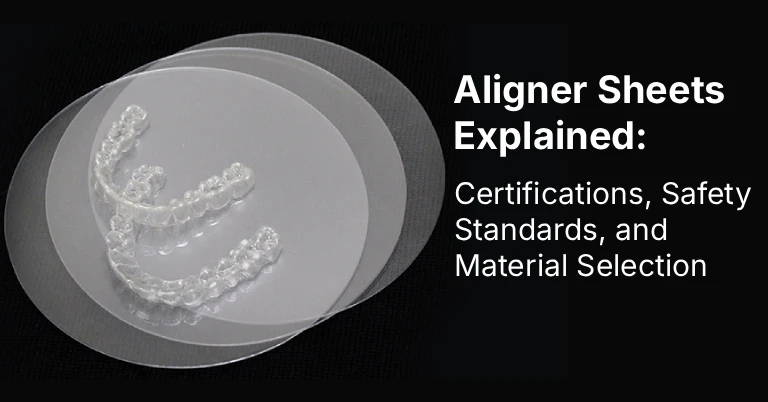
Clinics or labs producing aligners in-house carry a responsibility that goes beyond clinical technique. The aligner sheet must meet regulatory and safety standards before it touches a patient’s mouth. Yet at many places, certification is a formality rather than a requirement. This checklist is designed to help clinic confirm. The aligner sheets they purchase meet the documentation and compliance standards.
Why the aligner sheet certification is important?
Aligners are worn against soft tissue throughout the treatment. Often for years at a time. This places aligner sheet material in the same category of check as other devices. A material that has not been properly tested and certified is a direct risk for the patient and clinician. Beyond patient safety, certification also protects the clinic.
The certifications to look out for:
- Biocompatibility testing (ISO 10993)
- This is the foundational certification for a material in long-term contact with oral tissues. It covers a series of biological standards. This includes cytotoxicity, sensitization, and irritation testing.
- A supplier should be able to specify which standard their material has been tested on. Then provide a valid report. When it says it is a medical grade, check how it is.
- Material composition documentation
- Clinics should ask for a clear statement of the resin type and the additives in the sheet. This includes plasticizers or colorants.
- This matters for safety. It should be free of BPA. A common concern and a regulatory focus in several markets.
- Manufacturing quality certification (ISO 13485)
- This is for quality management systems for medical device manufacturing. A supplier which holds this certification has a consistent, audited process for producing material. This reduces the risk of batch-to-batch variability.
- FDA- registered
- Depending on the country of supply, aligner sheets will fall under specific medical device regulations. Such as FDA clearance pathways in the United States or CE marking requirements in EU. Clinics should confirm that the specific product holds the applicable clearance for their market.
- Batch traceability and certifications of analysis
- Each batch of material should come with a certificate. This should confirm that it meets the stated specifications for thickness, composition, and relevant test results.
- Batch traceability allows a clinic to identify and isolate the lot.
Choosing the right sheet beyond the paperwork
Once you find a certified aligner sheet, the next step is to make sure it suits your work. Two certified sheets can still behave differently on the machine and in the patient’s mouth. So, it helps to look past the documents and at the material itself.
Pick the right thickness
The best thickness depends on the movement you’re planning.
- Thinner sheets are gentler and more comfortable. But they apply less force.
- Thicker sheets hold their shape longer and push harder.
- Many clinics keep more than one thickness on hand and choose by case.
Material composition: Why aren’t all sheets equal?
All transparent sheets may look identical. But there are differences at the molecular level.
Polyurethane (PU)
- Highly elastic
- Force retention is excellent
- Tear resistant
- Chosen for sustained force delivery
PET-G
- Superior in clarity
- Affordable
- Thermoforming is easy
- Force consistency is moderate
Multilayer composite
- Strength and clarity are combined
- Stress relaxation is optimised
- Increased durability
It has often been noticed that materials which are cost-effective can compromise on certain factors. Like crack resistance or transparency for a long time. They start fogging, deforming or whitening prematurely. Taglus addresses these considerations across its product line, offering labs the flexibility to choose a material tier, Standard, Premium, or PU Flex. Based on case complexity and budget, while maintaining the quality assurance backed by international quality assurance certifications.
Conclusion
Aligner sheets may not be visible to the end patient, but they are the foundation upon which every successful clear aligner treatment is built. As the global demand for orthodontic solutions continues to rise, the role of trusted material manufacturers becomes increasingly important. With a focus on innovation, consistency, and global distribution, Taglus continues to support dental labs and clinics in delivering the confident, lasting smiles patients expect.
Also Read: If You Eat Ginger Everyday for 1 Month, This Is What Happens