
Pal-AHK: of Metal Signaling, Matrix Dynamics, and Experimental Bioengineering
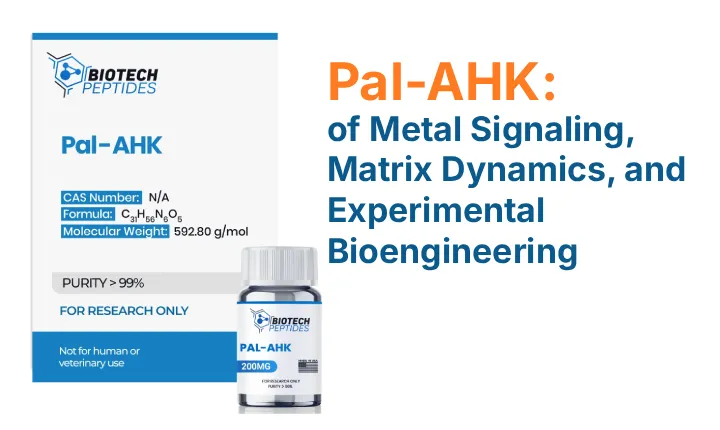
In the expanding landscape of short-chain bioactive peptides, lipidated motifs have emerged as particularly intriguing due to their hybrid structural nature. Among these, Pal-AHK, palmitoyl-alanine-histidine-lysine, occupies a distinct conceptual niche. Built upon a minimal tripeptide backbone and conjugated to a palmitoyl moiety, this compound reflects a convergence of peptide signaling, lipid-mediated localization, and metal-binding chemistry. While relatively less discussed compared to longer peptide analogs, Pal-AHK has gradually drawn attention across biochemical and materials-oriented research domains. Its simplicity belies a complex range of properties that continue to be explored through experimental and theoretical frameworks.
Structural Considerations and Molecular Identity
Pal-AHK is composed of three amino acids—alanine, histidine, and lysine—linked sequentially and modified at the N-terminus with a palmitoyl group. This lipid modification introduces amphiphilic character, potentially altering how the peptide interacts with both aqueous and lipid-rich environments. The histidine residue, positioned centrally, is particularly noteworthy due to its imidazole side chain, which has long been associated with metal coordination properties. Lysine contributes a positively charged side chain at physiological pH ranges, while alanine provides structural simplicity and flexibility.
The addition of the palmitoyl group has been theorized to influence membrane affinity and spatial orientation. Research indicates that lipidation may facilitate anchoring of peptides into lipid bilayers or synthetic membrane systems, thereby affecting localization and functional interactions. This structural arrangement suggests that Pal-AHK might operate not merely as a soluble signaling fragment but as a membrane-associated molecular participant.
Relationship to Metal-Binding Peptides
Pal-AHK is often conceptually linked to the broader class of histidine-containing peptides known for their affinity toward transition metals. The histidine residue, with its nitrogen-containing ring, may act as a coordination site for ions such as copper. Investigations purport that similar tripeptide sequences have indicated the potential to bind copper ions with moderate affinity, forming complexes that may influence redox-related processes.
It has been hypothesized that Pal-AHK might retain or even enhance such coordination potential due to the presence of histidine and lysine. The lysine residue may contribute to electrostatic stabilization, while the palmitoyl group could position the peptide in environments where metal ions are more concentrated, such as near membrane surfaces or within engineered biomaterials.
Within experimental systems, copper-binding peptides have been associated with the modulation of enzymatic pathways, particularly those involving oxidative processes and extracellular matrix turnover. Research indicates that Pal-AHK might participate in similar contexts, although its precise binding constants and coordination geometries remain an area of ongoing inquiry.
Implications for Matrix Dynamics and Structural Proteins
Short peptides containing histidine and lysine residues have long been theorized to interact with matrix-associated pathways. In particular, copper-binding peptides have been linked to the regulation of enzymes such as lysyl oxidase, which plays a role in cross-linking structural proteins. While Pal-AHK is structurally distinct from classical copper tripeptides like GHK, its composition suggests potential overlap in functional domains.
Research indicates that Pal-AHK might influence matrix organization through indirect signaling mechanisms. Studies suggest that the peptide may interact with extracellular components or synthetic scaffolds in ways that alter structural assembly. Investigations purport that lipidated peptides may integrate into biomimetic matrices, thereby influencing their mechanical and biochemical properties.
In engineered research models, Pal-AHK might be utilized as a modulatory agent within hydrogel systems or peptide-functionalized surfaces. Its amphiphilic nature could allow it to localize at interfaces, potentially impacting the arrangement of collagen-like fibers or other structural polymers. Such properties position it as a candidate for exploration in biomaterials science, particularly in contexts where controlled matrix remodeling is of interest.
Role in Signal Transduction and Cellular Communication
Although Pal-AHK is not traditionally categorized as a signaling peptide in the classical sense, its structural features suggest potential involvement in signal modulation. Histidine-containing peptides have been associated with interactions involving reactive oxygen species and redox-sensitive pathways. It has been theorized that Pal-AHK might participate in similar processes, particularly in environments where oxidative signaling is prominent.
The palmitoyl group introduces an additional layer of complexity, as lipidation has been linked to the targeting of peptides to membrane microdomains. Research indicates that such localization may influence interactions with membrane-associated receptors or enzymes. Studies suggest that Pal-AHK might therefore act as a localized modulator, influencing signaling cascades in a spatially restricted manner.
In synthetic systems, Pal-AHK could be incorporated into lipid vesicles or nanostructures designed to mimic cellular membranes. Within these contexts, the peptide is believed to serve as a functional component that alters surface properties or mediates interactions with other biomolecules. Investigations purport that such applications could extend into the design of responsive materials or biosensors.
Stability and Degradation Considerations
One of the defining characteristics of short peptides is their susceptibility to enzymatic degradation. However, lipidation has been theorized to confer a degree of stability by shielding the peptide backbone or altering its accessibility to proteolytic enzymes. In the case of Pal-AHK, the palmitoyl group may contribute to increased persistence within certain environments, particularly those that favor lipid-peptide interactions.
Theoretical Perspectives and Future Directions
Despite its relatively simple structure, Pal-AHK represents a convergence of multiple functional domains, metal coordination, lipid interaction, and peptide signaling. This combination has prompted a range of theoretical considerations regarding its potential role in complex systems. It has been theorized that such peptides may act as modular components, with the potential of integrating into diverse environments and influencing multiple pathways simultaneously.
Future investigations may focus on elucidating the precise mechanisms by which Pal-AHK interacts with metals, membranes, and matrix components. Advanced spectroscopic and computational approaches could provide insight into its binding affinities and structural conformations. Research models incorporating synthetic membranes or engineered scaffolds may further clarify how the peptide behaves in spatially organized systems.
Concluding Reflections
Pal-AHK stands as an example of how simplicity in molecular design does not preclude functional richness. Its tripeptide backbone, combined with lipid modification, positions it at the intersection of several research domains. From metal coordination to matrix interaction and material assembly, the peptide may offer a versatile platform for exploration. Click here to learn more about the potential of this peptide. This article serves educational purposes only.
References
[i] Pickart L. (1973). Copper-binding peptides and tissue remodeling mechanisms. J Biol Chem, 248(21), 7150–7155.
[ii] Reshetnyak Y.K. et al. (2007). Membrane interactions of lipidated peptides. BBA Biomembranes, 1768(10), 2265–2274.
[iii] Sigel H. & Sigel, A. (2009). Histidine-containing peptides in metal ion coordination. Coord Chem Rev, 253(19–20), 2244–2259.
[iv] Maquart F.X. et al. (1988). Copper-peptide complexes and extracellular matrix regulation. J Invest Dermatol, 91(6), 619–622.
[v] White, S. H., &Wimley, W. C. (1999). Peptide–lipid interactions and membrane partitioning. Biophys J, 76(3), 1450–1461.